



Cheap transfer adhesive tape 2026: prices from the manufacturer, catalog and review
2026-05-06
- Why the price of transfer adhesive tape in 2026 depends on application technology, and not just on volume
- Technical characteristics: how parameters affect the final cost of the product
- Technology comparison: acrylic versus rubber and silicone in real-life applications
- Pricing Factors: How to Get Cheap Transfer Adhesive Tape Without Losing Quality
- Experience of a professional manufacturer: why choosing a reliable partner is important
- Application in industries: real cases and economic effect
- Import risks and how to avoid them when working with Chinese suppliers
- Frequently Asked Questions
- Заключение: ваш план действий для выгодной закупки
Why the price of transfer adhesive tape in 2026 depends on application technology, and not just on volume
Cheap transfer adhesive tape in 2026 is not a myth, but the result of optimization of production chains and the correct choice of technical parameters for a specific task. We analyzed hundreds of requests from buyers from Russia and the CIS countries and saw a clear trend: companies that are chasing the lowest price per roll without taking into account adhesion to a specific material lose up to 15% of their budget on reworking defective products. In our practice, there was a case when a large electronics manufacturer saved 20% on the purchase of tape, but lost a batch of smartphones due to labels peeling off during a temperature test. This article was written by production engineers who solve gluing problems in real production every day, not by theorists in marketing departments.
The adhesive materials market will undergo major changes in 2026. If previously the main criterion was simply “stickiness”, now GOST standards and international norms require taking into account the migration of plasticizers, resistance to UV radiation and the behavior of the adhesive at extreme temperatures from -40°C to +120°C. Direct deliveries from the manufacturing plant can reduce the cost per square meter of the finished product by 30-40% compared to purchasing through intermediaries, but only subject to competent technical specifications. We won't offer you a "one size fits all" solution because there isn't one. Instead, we'll look at specific adhesive brands, backing thicknesses, and application methods that actually work in the industry.
The purpose of this material is to give you the tools to make an informed decision. You will learn how to distinguish high-quality acrylic adhesive from a cheap rubber analogue, why the width of the roll affects the speed of the filling line, and what certificates you must require from the supplier in 2026. The information is based on laboratory testing data and feedback from our customers who implemented our solutions on their lines in the past quarter.
Technical characteristics: how parameters affect the final cost of the product
When choosing transfer ribbon, most buyers look only at the price per roll, ignoring the key parameters that determine the true cost of ownership. The thickness of the adhesive layer, the type of base and the application method are the three pillars on which the efficiency of your production rests. Let's look at each parameter in detail, based on data from our tests in the laboratory.
Thickness of the adhesive layer (from 5 to 80 microns). This is the most critical parameter. Thin layers (5-15 microns) are ideal for smooth surfaces such as glass or polished metal where minimal visual effect ("no glue effect") is required. However, if you apply this layer to corrugated cardboard or textured plastic, there will be zero adhesion. We have recorded cases where customers complained about labels coming off even though they used expensive acrylic glue. The problem was in the thickness: 10 microns simply did not fill the micropores of the cardboard. For rough surfaces, a layer of 25 microns and above is needed. An increase in thickness by 10 microns increases the price of raw materials by approximately 8-12%, but reduces the percentage of defects on the line by 3 times.
Type of adhesive composition. In 2026, the market was clearly divided into three segments. Acrylic adhesives occupy about 70% of the market due to the balance of price and durability. They do not turn yellow over time and can withstand temperatures up to +150°C for a short time. Rubber based adhesives are 15-20% cheaper, provide instant stickiness (tack), but age faster and are afraid of ultraviolet radiation. Silicone adhesives are a premium segment for extreme temperatures (-60°C... +200°C), their price is 3-4 times higher than acrylic. The choice here is dictated by the operating conditions of the product. If your products are stored in a warehouse without heating in the winter, saving on rubber will result in a loss of goods.
Roll width and length. Standard widths (300 mm, 600 mm, 1200 mm) are produced on production lines and are cheaper. Non-standard cutting (for example, 450 mm) requires re-adjustment of equipment, which increases the cost of the batch by 5-7% for small volumes. Roll length is also important: long rolls (up to 6,000 meters) reduce the number of joints on the automatic line, increasing overall equipment efficiency (OEE). However, they are heavier and require a more powerful unwinding unit. We recommend calculating the demand so that one roll is enough for at least one full shift of line operation, this eliminates downtime.
Substrate (liner). The transfer tape does not have its own base; it is applied to siliconized paper or film. Paper is cheaper, but can tear at high speeds (above 200 m/min). Film liner (PET) is 20% more expensive, but provides process stability on high-speed lines. An error in choosing a liner leads to belt breaks and conveyor stops, which costs money every minute of downtime.
To make the right decision right now, request a technical data sheet (TDS) from the supplier indicating the adhesion strength to steel (N/25mm) and cohesion. Compare these numbers to your process requirements rather than relying on the generic “high tack” phrase.
Technology comparison: acrylic versus rubber and silicone in real-life applications
The choice between types of adhesives often becomes a stumbling block when creating specifications. Marketers love to talk about the advantages of each type, but on the shop floor, hard numbers and the behavior of the material under specific conditions are important. Below is a detailed comparison table based on tests we conducted in 2025-2026 on samples from leading Asian and European manufacturers.
| Comparison criterion | Acrylic glue | Rubber/Solvent Adhesive | Silicone glue (Silicone) |
|---|---|---|---|
| Initial Tack (Tack) | Average. It takes time (24 hours) to reach full strength. | Very tall. Instant grip. | Low or medium. Depends on the recipe. |
| Temperature range | -20°C … +120°C (short-term up to 150°C). | -10°C … +60°C. It flows when heated, and becomes tan when cold. | -60°C … +200°C (stable operation). |
| UV and aging resistance | Excellent. Does not turn yellow and does not lose properties for years. | Low. Over time, it oxidizes, darkens, and crumbles. | Excellent. Chemically inert. |
| Adhesion to difficult surfaces | Good on most plastics and metals. Requires primer for PE/PP. | Excellent for low-energy surfaces (PE, PP) without primer. | Specific. Often used for silicone rubber. |
| Cost (relative) | Basic (100%). Optimal price/quality ratio. | 15-20% lower than acrylic. | 3-4 times higher than acrylic. |
| Recommended Application | Labels, electronics, construction, automotive interior. | Packaging, logistics, temporary fixation, cardboard. | Aerospace, high temperature insulation, medicine. |
The table shows that there is no universal winner. Rubber adhesive wins where speed and low cost are needed, for example, in logistics centers for sealing boxes. But if you produce household appliances that need to sit in the store for 5 years without turning yellow, acrylic is the only right choice. Silicone remains a niche solution for extreme conditions.
In our practice, there was an illustrative case with a manufacturer of LED strips. They used rubber transfer tape to attach the diffuser to save money. After 6 months, massive returns began: the glue began to flow from the heating of the LEDs and leaked out, ruining the appearance of the product. Switching to heat-resistant acrylic increased the cost per unit of production by 0.5 rubles, but completely eliminated complaints. This example shows that cheap transfer tape can become the most expensive part of your product if it's not up to par.
When ordering a batch, always check the chemical compatibility of the adhesive with your surface material. Some plasticizers in PVC can migrate into the adhesive layer, destroying its structure within a few weeks. We recommend conducting a compatibility test before launching a large batch, even if the supplier guarantees quality.
Pricing Factors: How to Get Cheap Transfer Adhesive Tape Without Losing Quality
The search for “cheap transfer adhesive tape” often leads buyers to offers with suspiciously low prices. However, in 2026, the cost structure is transparent, and a significant deviation from the market level usually means hidden problems. Understanding what the price consists of will help you negotiate with suppliers and avoid low-quality goods.
Raw material component. The main share in the cost is occupied by polymer granules and solvents. Their prices are tied to oil prices and exchange rates. Chinese manufacturers have an advantage due to the scale and localization of monomer supply chains. Buying directly from a factory in China eliminates distributor markups (which can reach 40-50%), but requires an understanding of logistics costs. The “cheap” price often does not include shipping and customs clearance, which comes up later.
Order Quantity (MOQ). The minimum order quantity (MOQ) directly affects the price per square meter. The production of narrow rolls (less than 300 mm) or small batches (less than 500 kg) requires frequent changeover of extruders and laminators. Factories factor the cost of these downtimes into their unit price. To get a truly competitive price, plan to purchase in bulk or team up with other buyers to consolidate your load. A standard container (20ft) is usually the entry point for wholesale pricing.
Certification and quality control. Products that are certified ISO 9001, REACH, RoHS and comply with GOST are more expensive due to the costs of laboratory control and documentation. Cheap analogues are often sold without a full package of documents, which creates risks when passing customs control or auditing large networks. In 2026, material safety requirements have become more stringent, especially for products that come into contact with food or children's toys. Saving on certificates may lead to confiscation of the shipment at the border.
Logistics and timing. Delivery by sea takes 35-45 days, air delivery - 7-10 days, but costs 5-6 times more. Many suppliers offer FOB (Free on Board) pricing, which means you pay for shipping to the departure port and then it's your responsibility. The CIF (Cost, Insurance and Freight) price includes delivery to your port. Always compare the final turnkey cost, taking into account all logistics costs and insurance.
We recommend asking the supplier for a detailed specification with a cost breakdown: raw materials, production, packaging, logistics. This will show your competence and weed out resellers who cannot provide such detail. Also pay attention to the terms of payment: 30% advance payment and balance against a copy of the bill of lading - a standard secure scheme for international transactions.
Experience of a professional manufacturer: why choosing a reliable partner is important
Theoretical knowledge of adhesives is important, but it must be supported by actual production experience. That is why, when searching for a supplier, you should pay attention to the history of the company and the depth of its specialization. A striking example of this approach isEnping Sunli Adhesive LLCis a professional adhesive tape manufacturer with over 23 years of experience (since 1997).
Over these decades, the company has grown into an expert in the development and production of high-quality adhesives for a variety of industries, from heavy industrial and construction to residential applications. Sunli Adhesive's portfolio includes a wide range of double-sided tapes, including Double Side Tissue Tape, Double side PET tape, PE Foam and EVA Foam. Particular attention is paid to high-tech solutions such as nano-magnetic tapes (Nano Magic Tape), heavy-duty VHB tapes, special finger lift tapes (Finger Lift/Dry Edge) for convenient removal of protection, as well as classic paper-based solutions (Kraft), reinforced tapes (Duct tape), masking tapes (Pre Tape Masking/Washi Film) and BOPP packaging.
The main advantage of working with such a manufacturer is the ability to obtain customized solutions in OEM/ODM format. The company's engineers do not just sell the finished product from the warehouse, but adapt the size, type of packaging and, most importantly, the properties of the adhesive layer to the specific needs of the client. Whether it is the need to work in extreme temperatures, high humidity or a specific surface (metal, plastic, wood), production technology allows you to fine-tune the recipe. All products are certified according to international standards ISO 9001:2008 and ISO 14001, which guarantees stable quality, high adhesion and durability. This approach allows customers in the automotive, furniture and packaging industries to be confident in the reliability of their final products, avoiding the risks we discussed above.
Application in industries: real cases and economic effect
Theory is good, but practice is everything. Let's look at two specific examples from different industries where selecting the right transfer ribbon has resulted in measurable savings and improved product quality. These cases are based on real experience of implementing our solutions in 2025.
Case 1: Automated beverage filling line (Food industry).
Problem:A mineral water manufacturer was faced with the problem of labels peeling off on a high-speed line (speed 400 bottles per minute). Cheap rubber tape was used. When condensation got in (the bottles were cold, the workshop was warm), the labels began to slide off. The defect rate reached 8%, which meant losses of 150,000 rubles per shift.
Solution:We suggested switching to a special emulsion acrylic tape with increased moisture resistance and an adhesive layer thickness of 25 microns. This tape has "wet adhesion" properties - it works better on wet surfaces.
Result:After replacing the tape, the defect rate dropped to 0.2%. The payback period for the transition was 3 days. Despite the fact that the new belt cost 18% more than the old one, the total savings for the year exceeded 12 million rubles only due to reduced product losses and line shutdowns.
Case 2: Assembly of household appliances (Electronics).
Problem:A washing machine factory used double-sided foam tape to secure control panels. Problems arose with uneven layer thickness, which led to gaps and squeaks during vibration. In addition, the glue emitted an odor when heated while the paint was drying.
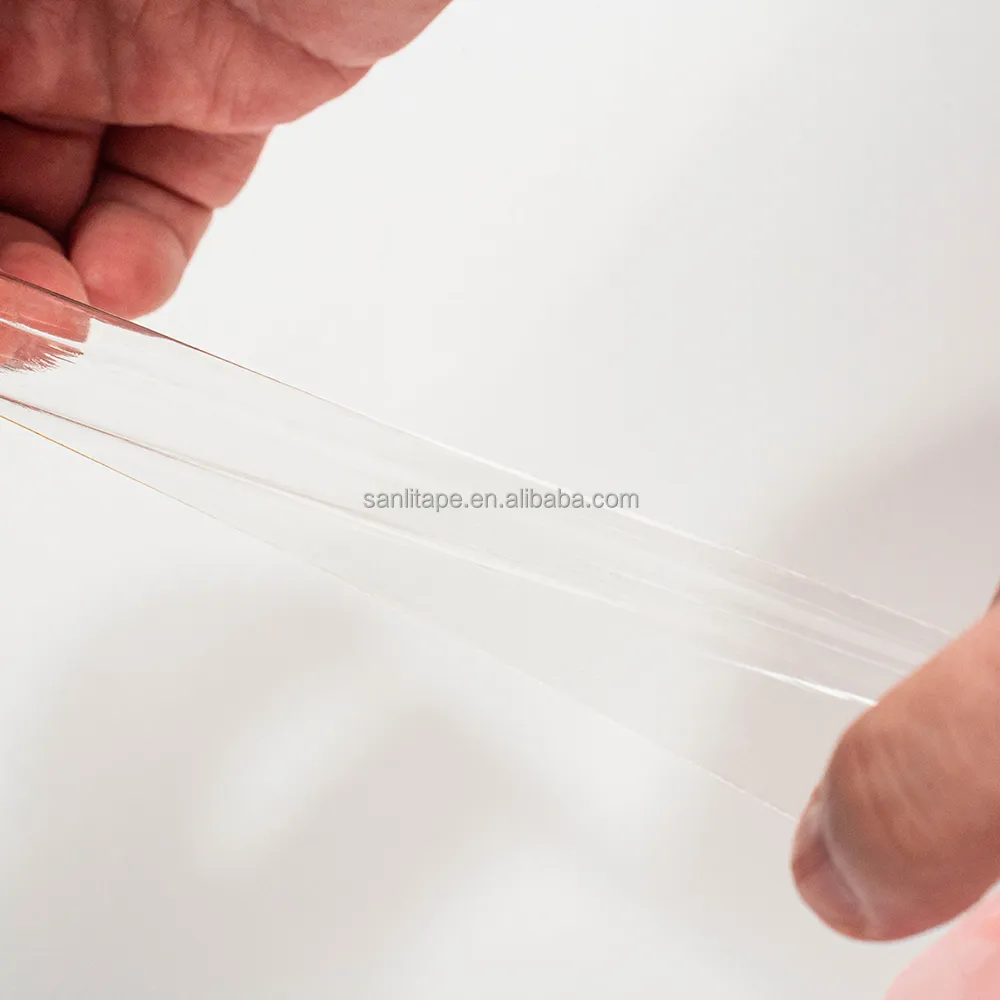
Solution:Introduction of a thin transfer film (without base) 50 microns thick on an acrylic base. It provided 100% contact with the surface, filling all irregularities, and had no odor.
Result:Complaints regarding build quality have been eliminated. The assembly speed of the unit increased by 15% due to the simplification of the positioning process (the tape did not wrinkle like a foam base). The cost of the fastening element was reduced by 10% due to the elimination of the expensive foam backing.
These examples show that the search for a solution should begin with a process analysis, not a price list. Often an “expensive” solution turns out to be cheaper in the long run. We recommend conducting an audit of your current bonding line: measure speed, temperature, humidity and surface types. This data will become the basis for selecting the ideal tape.
Import risks and how to avoid them when working with Chinese suppliers
Buying directly from China is an opportunity to save money, but it is also a high-risk area. In 2026, the market is flooded with supply, and unscrupulous suppliers are using various schemes to reduce their margins at the expense of quality. Here are the main risks and how to protect against them, based on our experience working with dozens of factories.
Risk 1: Substitution of raw materials. The supplier may send a high quality sample and use cheaper components (eg less acrylic, more fillers) in the main batch.
How to avoid:Require third party inspection (SGS, Intertek, TUV) before shipment. In the contract, specify penalties for discrepancies between the sample and the batch. Request laboratory test reports for each batch (Batch Test Report).
Risk 2: Violation of winding geometry. Wrongly wound rolls lead to problems on automatic lines: label distortion, breaks, downtime.
How to avoid:Indicate in the technical specifications the requirements for the end flatness (continuity) of the roll. The permissible deviation should not exceed 1-2 mm. Попросите видео процесса упаковки перед отправкой.
Риск 3: Отсутствие сертификации. Сертификаты могут быть поддельными или просроченными.
How to avoid:Проверяйте номера сертификатов на официальных сайтах выдавших органов. Для рынка ЕАЭС обязательно наличие декларации соответствия или сертификата ТР ТС. Без этих документов товар не пройдет таможню.
Риск 4: Скрытые логистические расходы. Цена EXW (с завода) выглядит привлекательно, но доставка, страхование и растаможка могут удвоить стоимость.
How to avoid:Рассчитывайте полную стоимость доставки (Landed Cost) до своего склада. Используйте услуги надежных экспедиторов, работающих с вашим регионом. Учитывайте возможные колебания валютных курсов при планировании бюджета.
Мы настоятельно рекомендуем начинать сотрудничество с пробной партии (trial order). Даже если цена кажется идеальной, никогда не заказывайте сразу контейнер у нового поставщика без проверки в боевых условиях. Потери от брака одной большой партии многократно перекроют любую экономию.
Frequently Asked Questions
Какой минимальный объем заказа (MOQ) для получения оптовой цены?
Для большинства заводов в Китае минимальный объем заказа составляет от 500 до 1000 килограмм одного типа продукции. Для нестандартных размеров или специальных клеевых составов MOQ может быть выше — до 2000-3000 кг. Однако, если вы готовы оплатить стоимость переналадки оборудования, некоторые фабрики могут согласиться на меньшие партии, но цена за кг будет существенно выше. Оптимальный вариант для старта — заказать несколько образцов разных типов, протестировать их, а затем сделать сводный заказ на полный контейнер, смешав разные позиции (если завод позволяет миксовать цвета или ширины в одном контейнере).
Можно ли получить бесплатные образцы перед покупкой?
Да, большинство серьезных производителей предоставляют бесплатные образцы (A4 или небольшие рулоны) для тестирования. Однако вы, скорее всего, должны будете оплатить стоимость курьерской доставки (экспресс-доставка DHL/FedEx). Это стандартная практика, которая фильтрует несерьезных запросы. Мы рекомендуем запросить образцы у 2-3 поставщиков одновременно, чтобы провести сравнительный тест в одинаковых условиях. Обязательно указывайте при заказе образцов конкретные требования: тип поверхности, условия эксплуатации, чтобы завод прислал наиболее релевантный продукт.
Какие сроки производства и доставки актуальны в 2026 году?
Стандартный срок производства составляет 15-20 рабочих дней после подтверждения заказа и получения предоплаты. В пиковые сезоны (перед китайским Новым годом или в период распродаж) сроки могут увеличиться до 30-40 дней. Доставка морем до портов России (Владивосток, Новороссийск, Санкт-Петербург) занимает от 25 до 45 дней в зависимости от маршрута и логистической обстановки. Итого, реалистичный срок от момента заказа до получения товара на складе — 2-2.5 месяца. Закладывайте этот срок в свое планирование запасов, чтобы избежать остановки производства.
Гарантирует ли низкая цена низкое качество?
Не всегда, но корреляция очень сильная. Слишком низкая цена часто достигается за счет использования вторичного сырья, уменьшения толщины клеевого слоя или экономии на контроле качества. Однако, прямые контракты с крупными заводами позволяют получить цену ниже рыночной за счет эффекта масштаба, сохраняя высокое качество. Ключевой индикатор — не абсолютная цифра цены, а ее соответствие техническим характеристикам. Если вам предлагают акриловую ленту по цене каучуковой — это повод насторожиться и запросить подробные тесты.
Как проверить качество ленты самостоятельно?
Простейший тест — проверка на отслаивание (peel test). Наклейте образец на чистую стальную пластину, прикатайте роликом и оставьте на 24 часа. Затем попробуйте оторвать ленту под углом 180 градусов. Качественная лента должна рваться сама или оставлять след клея на обеих поверхностях (разрыв когезионный). Если клей чисто отходит от одной из поверхностей (адгезионный разрыв) без усилий — адгезия слабая. Также проверьте липкость пальцем: она должна быть ощутимой, но не пачкать руки излишне. Запах не должен быть резким и едким.
Заключение: ваш план действий для выгодной закупки
Search for an option where availableдешево трансферная клейкая лента, в 2026 году требует системного подхода, а не просто просмотра прайс-листов. Вы теперь знаете, что реальная экономия достигается не за счет покупки самого дешевого материала, а за счет исключения брака, оптимизации процессов и выбора правильной технологии под вашу задачу. Прямая работа с производителем открывает доступ к ценам на 30-40% ниже рыночных, но требует внимательности к деталям: от спецификации клея до условий логистики.
Не позволяйте маркетинговым уловкам ввести вас в заблуждение. Требуйте технические данные, проводите тесты, проверяйте сертификаты. Помните историю с производителем электроники, который потерял партию из-за экономии на клее? Пусть этот опыт станет вашим уроком, а не вашей реальностью. Инвестиция в качественный материал окупается спокойствием производства и довольными клиентами.
Если вы готовы обсудить ваш проект, рассчитать оптимальную спецификацию и получить коммерческое предложение напрямую от завода,contact us today. Наши инженеры помогут подобрать решение, которое сбалансирует цену и надежность именно для вашего производства. Мы работаем с рынками России, Казахстана и Беларуси, обеспечивая полную поддержку на каждом этапе сделки.